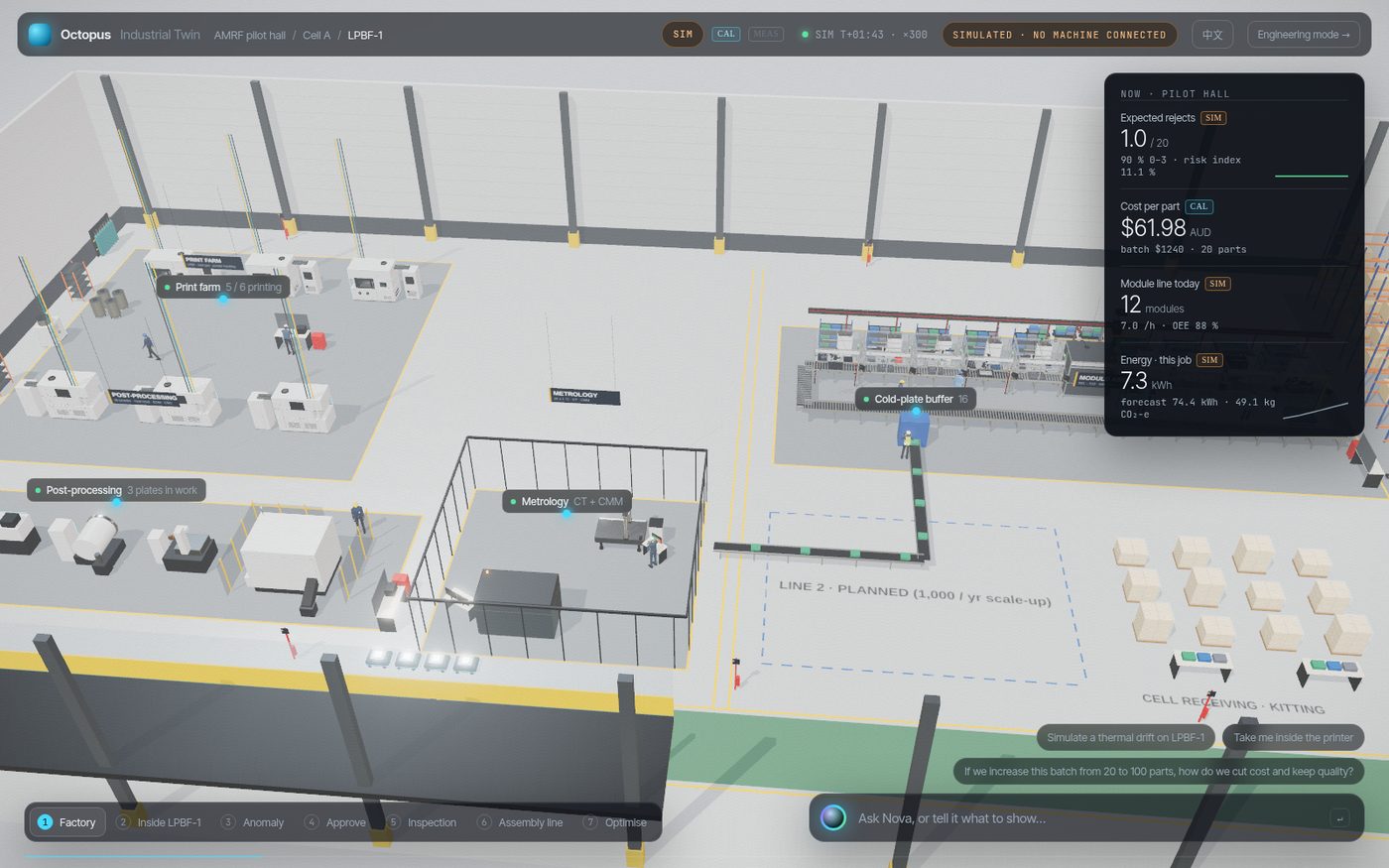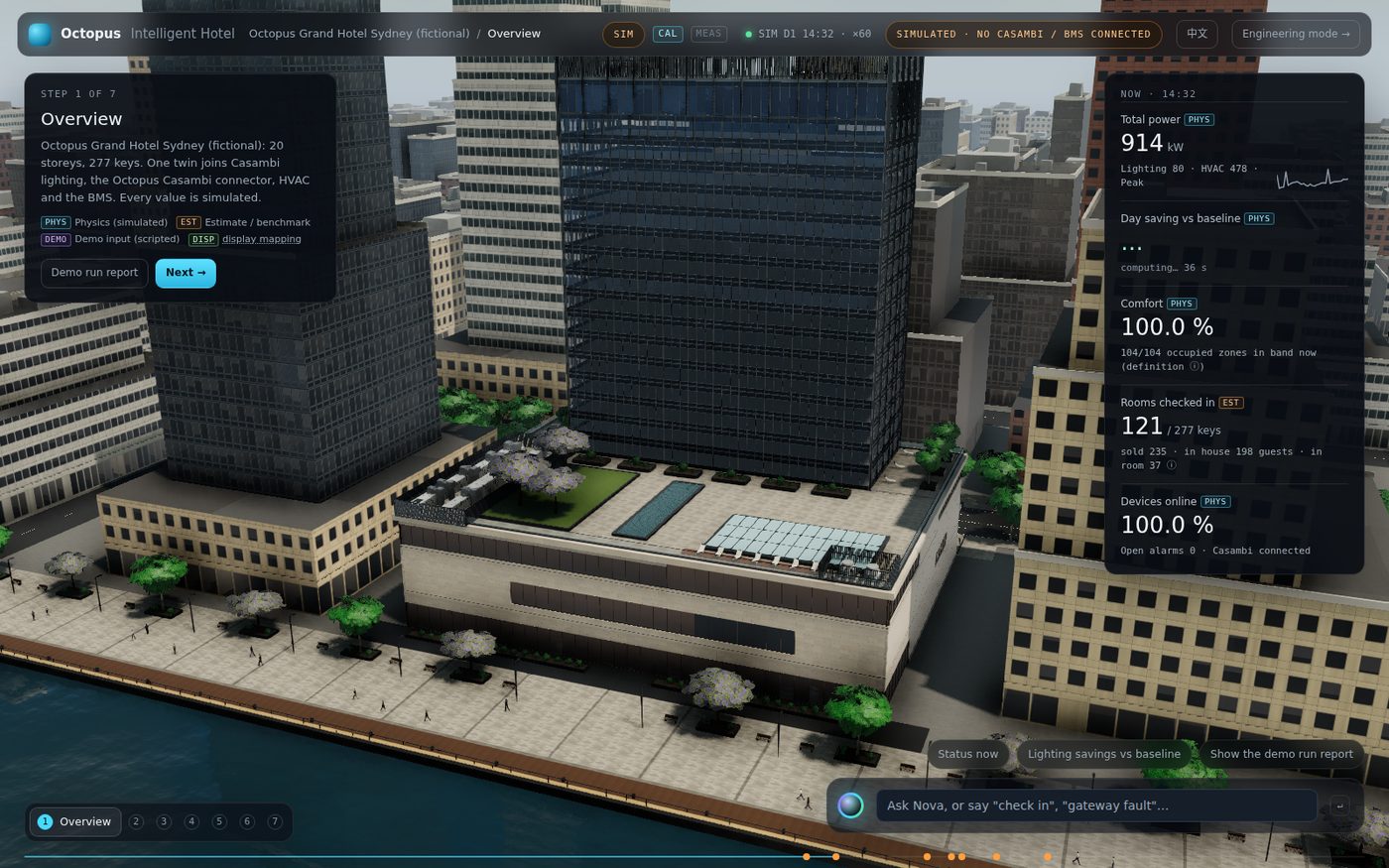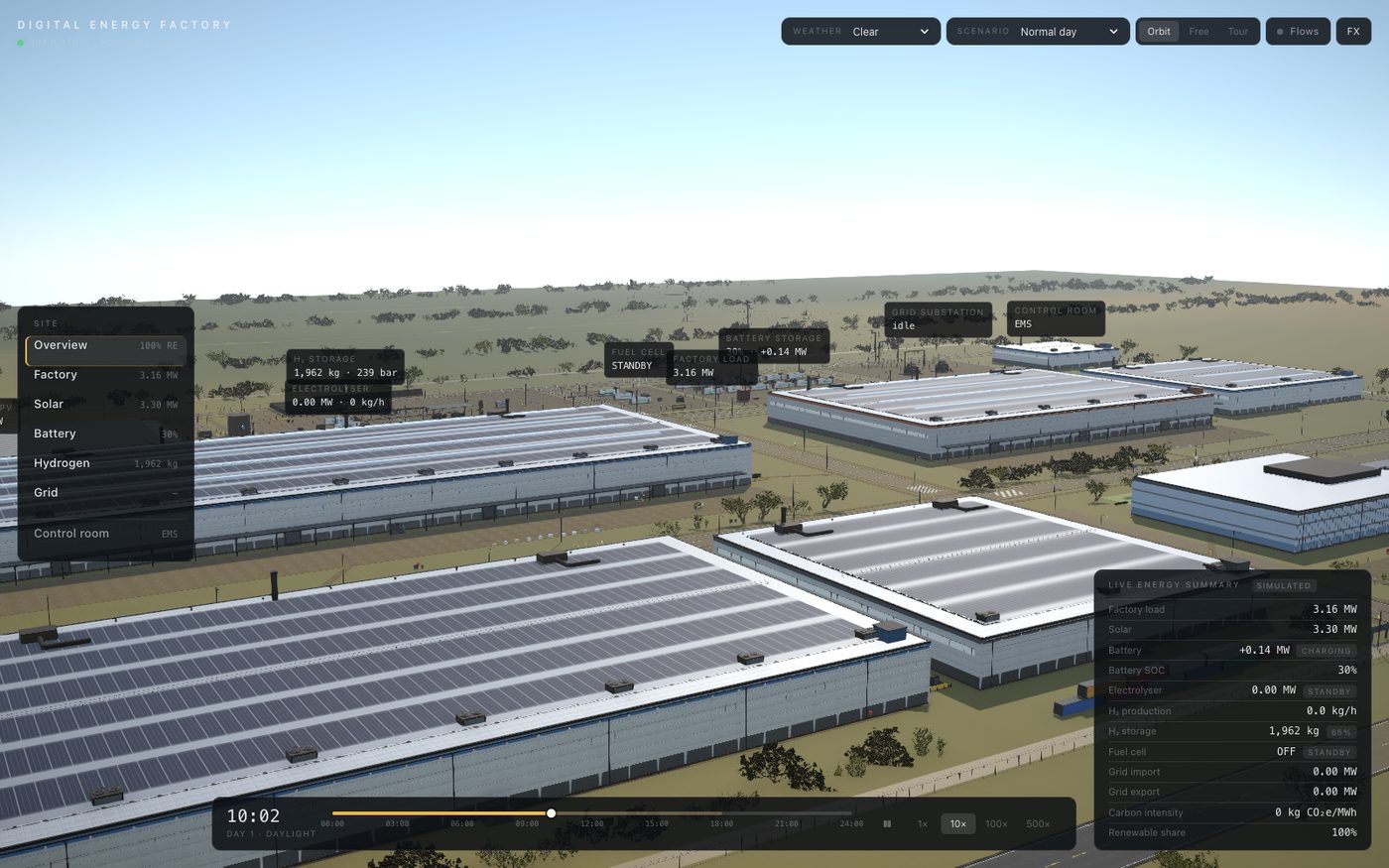
Every business owner eventually faces a decision that is expensive to get wrong and impossible to rehearse. Replace the chillers or tune the controls? Add a second shift or a second line? Re-slot the warehouse before peak season? Switch rice suppliers across five stores? You cannot run the business twice to see which choice was right.
A digital twin is a way to run it twice.
The short definition
A digital twin is a working model of a physical operation — a building, a plant, a pipeline, a warehouse, a restaurant group — that behaves like the real thing closely enough to answer business questions. It is fed by data about the real operation, it follows the same rules (physics, schedules, recipes, contracts), and it can be pushed forward in time under different choices.
Three things it is not:
- Not a 3D model. A beautiful model of your factory is a picture. It becomes a twin only when the things in it have state — temperatures, stock levels, queue lengths, costs — that change for the right reasons.
- Not a dashboard. A dashboard tells you what happened. A twin can tell you what would happen if you did something different.
- Not magic AI. The useful part is usually engineering and accounting done carefully: energy balances that add up, inventory that reconciles to the cent, timelines that can be replayed.
Four questions, four levels
The easiest way to judge any twin — ours or a vendor's — is to ask which of these questions it can actually answer. We describe this in more detail in the four generations of digital twins.
- What does it look like, and where is everything? A digital model. Useful for training, sales and planning space. Our Universe and Human Body explorers live here.
- What state is it in right now? A digital shadow: live or recorded data flows in, and the model estimates what the sensors cannot see — with error bars. Our visual-navigation lab is one.
- What happens if we run it this way? A digital twin in the full sense: simulation, scenarios and a baseline to compare against. Most of our work — buildings, hotels, warehouses, restaurants, energy, manufacturing — sits here.
- What changed, when, why, and where does it lead? A 4D causal twin: history, present and several possible futures on one timeline, with causes derived from the difference between futures. Our pipeline and crop twins work this way.
A vendor who cannot say which question their product answers is selling a level-1 model at a level-3 price.
Where the value comes from
In our experience the money in a digital twin comes from four places.
1. Decisions made before the spend. The biggest returns come before any hardware is bought. Sizing batteries and hydrogen for a house, choosing a dispatch strategy for an energy campus, picking build parameters for a printed part, re-slotting a warehouse: each of these can be tested on the twin for the cost of compute, instead of on the site for the cost of a mistake.
2. Savings you can prove. Energy and efficiency projects are usually sold as a percentage. With a twin you can run a baseline copy of the operation next to the improved one, on the same weather, occupancy and demand. The saving is a measured difference, not a promise — which is what your finance team and your lender actually want. We wrote about this in measured, not claimed.
3. Problems found earlier. A drifting sensor, a stuck damper, a supplier price creep, an over-portioning store: each of these costs money quietly for weeks. A twin knows what should be happening, so the gap between expected and observed becomes a signal rather than noise.
4. One picture everyone agrees on. Owners, operators, engineers, financiers and auditors usually look at different spreadsheets. A twin puts them in front of the same model, with the same numbers, where any figure can be traced back to its source. That shortens meetings and reduces arguments more than any single algorithm.
What changes in the business
When a twin is working, the most visible change is in how decisions are made:
- From opinion to comparison. “I think” becomes “here are the two futures side by side”.
- From annual reviews to continuous checks. Performance is compared with the baseline every day, not once a year.
- From vendor claims to evidence. Savings, risks and results come with the assumptions attached.
- From experts' heads to a shared model. Knowledge about how the operation behaves stops leaving when a key engineer does.
How to buy one without buying a demo
Digital twins are easy to demo and hard to deliver. Some questions worth asking any supplier, including us:
- Which business decision will this twin change? If the answer is “visibility”, keep asking.
- What is the baseline? Without one, savings are claims.
- Where does every number come from? Ask to click a figure and see its source: a dataset, a published model, a measurement or a labelled assumption.
- What is simulated and what is measured? A trustworthy twin labels them on screen.
- How is it tested? Ask for the acceptance checks, not just the video.
- What happens when the data is wrong? Good twins detect bad sensors instead of believing them.
- Who owns the model and the data? You should be able to keep both.
How we work
We start small and keep the twin honest at every step:
- Discovery — one workshop to pick the decision that matters and the data that exists.
- Prototype — a working twin of your site or process, usually on a sample of your own data, running in a browser so it can be shown to a board without installs.
- Connected twin — live feeds from your BMS, SCADA, WMS, POS or ERP, calibration against real measurements, and a baseline for measurement and verification.
Every one of our fourteen live twins carries a badge where data is synthetic, and every case study lists what has not been validated. We think that is the minimum a buyer should expect.
Where to start
Browse the projects by industry and open any twin in your browser — no account needed. The rest of this series takes each twin in turn and explains, in business terms, the problem it addresses and what it would take to build one for your site. If one of them looks like your problem, tell us about it.