
Fieldwork — Visual Localization
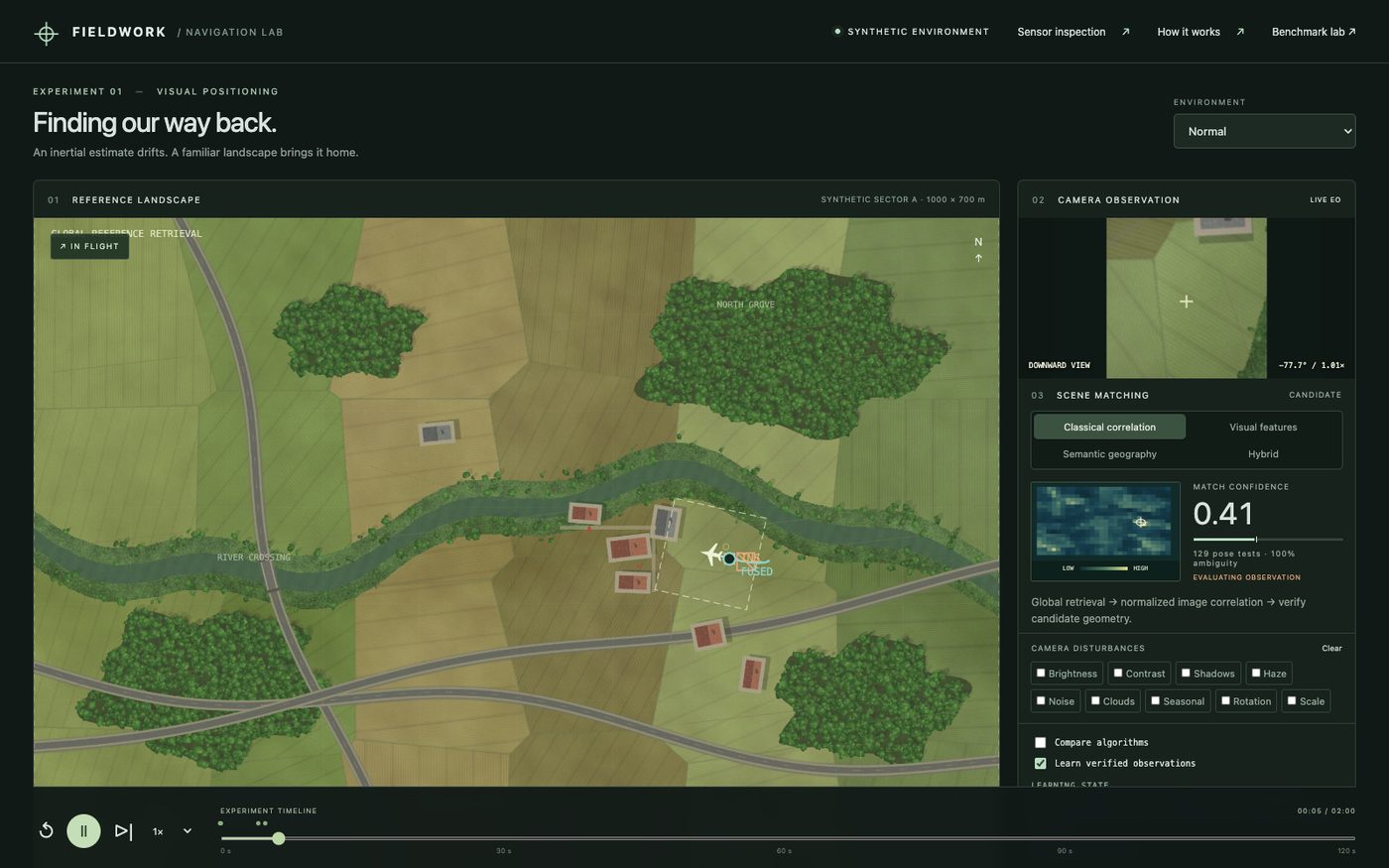
Where is the vehicle, given only what its camera sees? Reference and live images are independent renders of the same synthetic terrain; classical, feature-based, semantic and hybrid localisers correct an inertial drift, with measured error bounds.
- scenario cases
- 27
- evaluation records
- 2,300
- accepted-fix success, hybrid
- 85 %
- memory admissions / wrong
- 6 / 0
The challenge
When GNSS is degraded, a vehicle must localise from vision — and must refuse a fix it cannot support. Most benchmarks leak ground truth or hide failures.
What we built
- Truth held only by the evaluator; independent reference and live renders
- Four localisers incl. hybrid with candidate-evidence inspection
- Protected observation memory and learning replay
- Fixed protocol, seeded runs and ablations
Outcome in the twin
The hybrid localiser succeeds on 19/20 observations at low severity, rejects low-texture and ambiguous scenes instead of guessing, and every failure is kept in the report.
Path to production
Train and evaluate on the customer’s imagery and terrain; integrate with the vehicle’s inertial navigation.
Technology
About this build
Synthetic world; confidence is a heuristic score, not a calibrated probability. Engineering report →
Facility Twin · Care
Universe Explorer
Have a system you want to see, question or rehearse?
Tell us about the site, the process and the decision. We will come back with what a twin could answer, which data it needs, and how fast a prototype can be in front of your team.