HVAC optimisation is usually sold as a percentage. The percentage is hard to dispute and impossible to verify, because the question it answers — how much energy would the building have used without the change? — has no measured answer. The building only runs once.
A twin can run it twice.
Two towers, one weather file
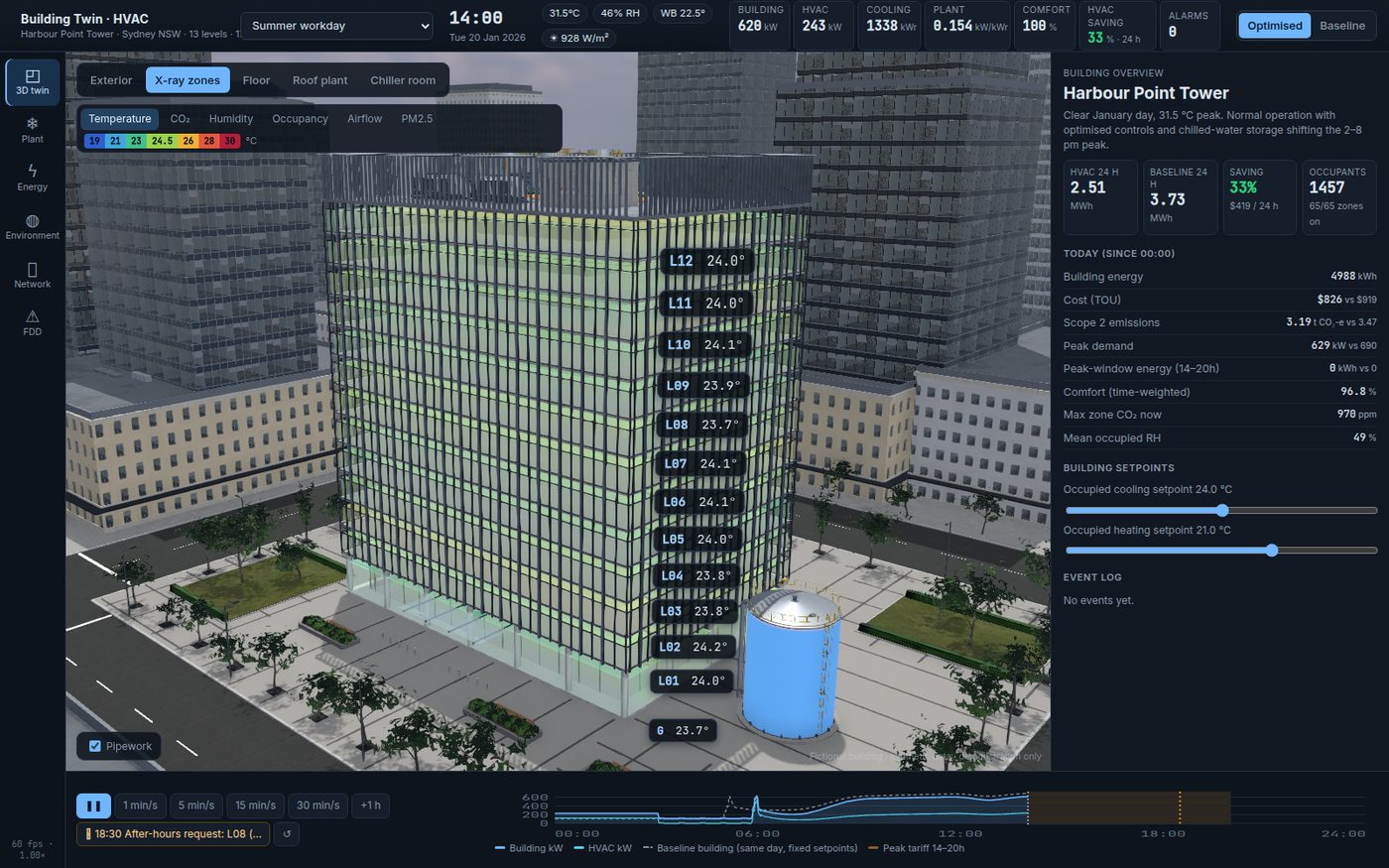
Our Building Twin · HVAC simulates a 13-level office tower in 60-second steps: 65 thermal zones, 13 floor air-handling units, chillers, cooling towers, heat pumps and a 6 MWh chilled-water store. Two copies of that model run in lockstep on the same weather, occupancy and tariffs:
- the baseline twin uses conventional control;
- the optimised twin adds supply-air temperature resets, demand-controlled ventilation, optimum start and off-peak storage.
The saving is simply the difference between the two meters. On the summer design day it is about a third of HVAC energy. It is not a claim about the strategy in general — it is a measurement on this building, these inputs and these assumptions, all of which can be inspected.
Faults erase savings quietly
The same structure makes fault detection honest. We inject six faults — a drifting supply-air sensor, a stuck VAV damper, a cooling-tower fan drive fault, a lost MS/TP trunk, a chiller trip and a stuck outdoor-air damper — and the fault-detection rules may only use points a real BMS would expose: 1,063 BACnet and Modbus points across 88 devices, tagged with Brick classes. If a rule needs a value the building does not measure, it does not get to use it.
From demo to M&V
On a real building, the baseline twin becomes the reference for measurement & verification. Calibrate zone and plant models against trend logs, freeze the calibrated baseline, then let the live building and the baseline run side by side. The difference — with its uncertainty — is the saving.