
Industrial Twin · Additive Manufacturing
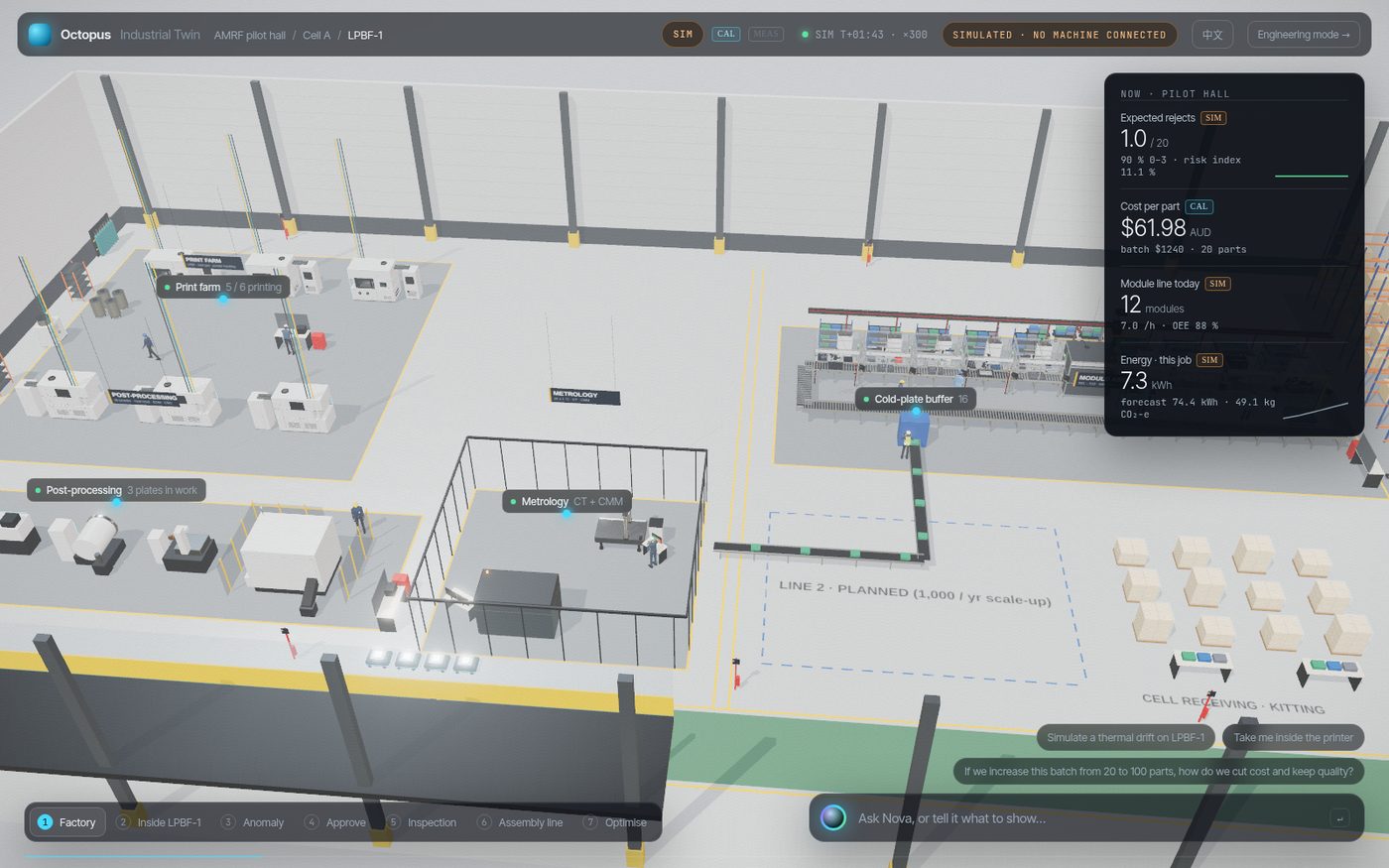
An advanced-manufacturing facility that prints a gyroid-lattice cold plate for a battery module in AlSi10Mg by laser powder-bed fusion, then feeds a ten-station module line. Nova, a deterministic planner, searches every build plan for cost, time and risk; faults raise an alert that a person approves before parameters change, and every number carries its provenance.
- build plans searched by Nova
- 384
- simulated cost per part at 100 parts
- $52.53 → $32.57
- printers + module-line stations
- 6 + 10
- presentation + engineering e2e checks
- 39 + 22
The challenge
Additive manufacturing promises lighter, better-cooled parts, but every build is expensive and slow. Engineers need to choose parameters, spot drift and plan the downstream line without burning machine hours — and without anyone mistaking a simulation for a validated process.
What we built
- Exhaustive deterministic planner over orientation, layer, laser and batch options — no black-box model
- Thermal-drift and recoater-wear scenarios: alert → human approval → parameters pushed
- Production-flow twin of printer farm, post-processing, metrology and a 10-station module line with OEE and bottleneck
- Provenance chips SIM / CAL / MEAS / VAL, model cards and an evidence ledger behind every result
- Presentation mode for the story, engineering mode on the same state
Outcome in the twin
A seven-step story takes a viewer from part design to tomorrow’s module supply, showing what Nova changes (cost per part, lead time, rejected parts) and which figures are simulated or calibrated, never measured.
Path to production
Connect the printers’ build logs and in-situ monitoring, calibrate the drift models on real builds, and move the provenance chips from SIM to MEAS.
Technology
About this build
Fictional facility; all parameters and results simulated or calibrated to a brief; not connected to any machine.
Building Twin · HVAC
Have a system you want to see, question or rehearse?
Tell us about the site, the process and the decision. We will come back with what a twin could answer, which data it needs, and how fast a prototype can be in front of your team.