If you run or are buying into metal additive manufacturing, you already know the economics. A single laser powder-bed fusion build can tie up a printer for most of a shift, consume expensive powder and still produce parts that fail inspection. Every trial build to tune parameters is machine time you are not selling. And when the printed part feeds an assembly line — a cold plate for a battery module, a bracket for an aircraft, a manifold for a pump — a bad build is not just scrap. It is a gap in tomorrow's supply.
The decisions that drive the cost are made early and with little evidence: how to orient the part, what layer thickness, which laser settings, how many parts per plate, which printer, and when to intervene if the process starts drifting. Those choices are usually made on experience, and checked only after the expensive part is done.
What a digital twin means here
A digital twin is a model of your physical system that you can question before you act. It is not a 3D picture of the factory. Its value lies in what it can answer: if we print this batch this way, what will it cost, how long will it take, how many parts are likely to fail, and what does that do to the line downstream? (We explain the general idea in What is a digital twin?.)
In manufacturing, the twin covers the part, the process, the quality checks, energy and cost together. You no longer study the printer, the inspection room and the assembly line separately. You can see what a decision in one of them does to the others.
What we built
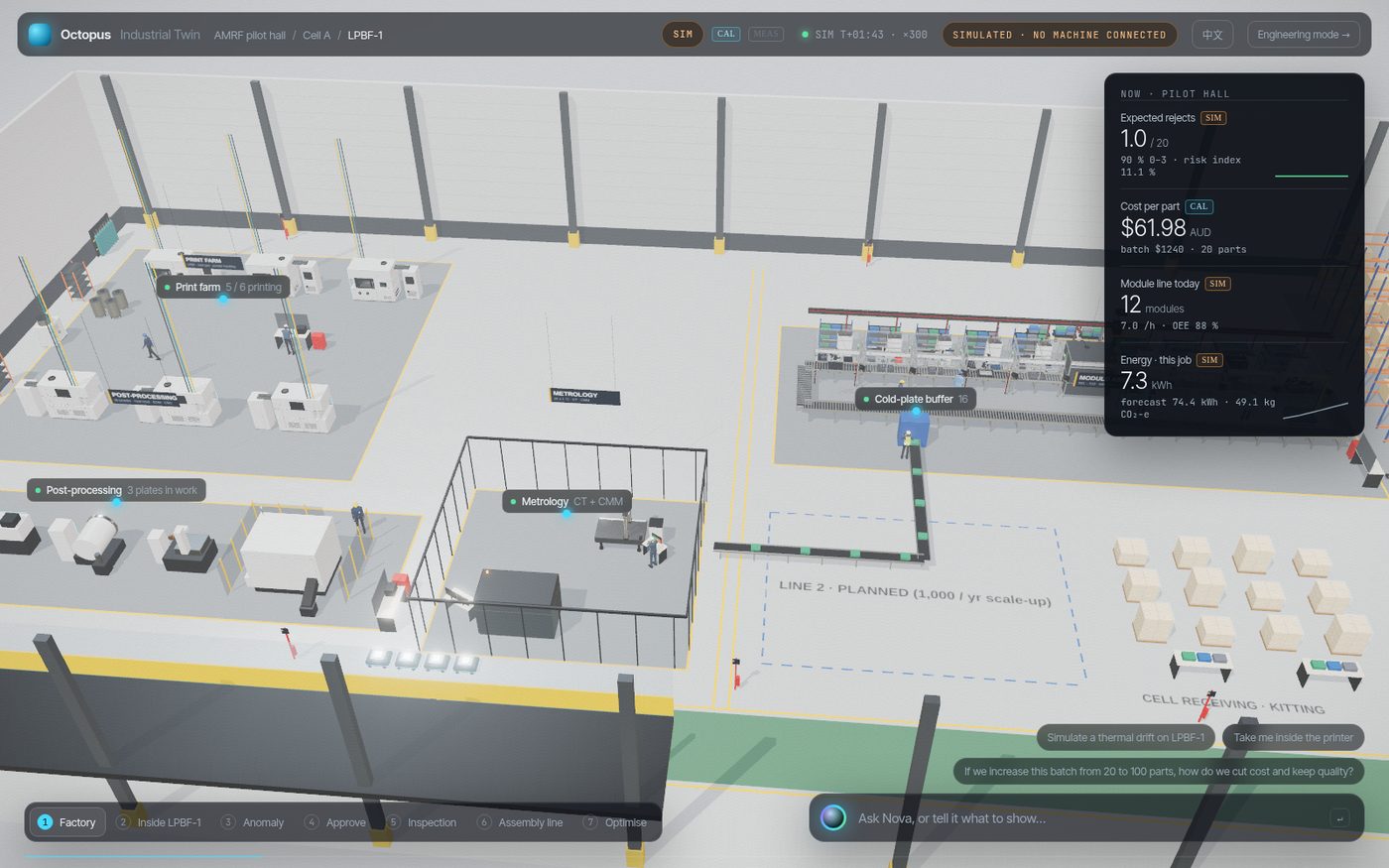
Our Industrial Twin is a fictional advanced-manufacturing facility. Its story follows a gyroid-lattice cold plate for a battery module, printed in AlSi10Mg by laser powder-bed fusion. The plates move through post-processing and metrology and then feed an energy-storage module line.
- A 76 × 42 m production hall in two linked parts. A metal AM pilot line has a powder room, a six-printer farm, autonomous mobile robots moving build plates through de-powdering, stress relief, wire EDM, a five-axis CNC cell, and CT and CMM metrology. Behind it runs a ten-station module assembly line, from cell loading to pack-out. The station that fits cold plates draws from the AM buffer and stops when the buffer is empty.
- Nova, a deterministic planner. Nova searches every one of 384 build plans (orientation, layer, laser, batch and printer options) for cost, time and risk. No black-box model is involved, so anyone can re-derive the result. In the demo, scaling the batch from 20 to 100 parts brings the simulated cost per part from $52.53 to $32.57.
- Fault scenarios with a human in the loop. Thermal drift and recoater wear raise an alert. Nova proposes a parameter change, a person approves it, and only then are parameters pushed. Every step goes into an evidence ledger.
- A production-flow twin. It tracks OEE (availability × performance × quality) per station and for the whole line, shows the bottleneck and the buffers, and works out what a delayed build means for tomorrow's module supply.
- Honest provenance. Every number carries a chip: SIM (model with assumed parameters), CAL (fitted to reference figures), MEAS (measured) or VAL (validated). In the demo nothing is MEAS or VAL, and the screen says so.
Decisions it helps you make
- Which build plan gives the lowest cost per part at the risk we can accept, and how does that change with batch size?
- If we add a seventh printer, does the module line actually produce more, or does the bottleneck just move to post-processing or inspection?
- A printer shows thermal drift mid-build. Do we stop, adjust or finish, and what does each choice do to tomorrow's supply?
- How much of our cost is machine time, powder, energy, post-processing and scrap?
- Which numbers in this proposal are measured, and which are modelled?
What changes
Before: parameters come from experience and trial builds, quality problems show up at CT inspection, and the assembly line learns about a missing cold plate when it runs out. Investment cases for new printers rest on spreadsheet utilisation figures.
After: candidate plans are compared on screen before a build starts. Drift is visible as it develops, and the response follows an approval path that leaves a record. The planner and the line manager look at the same buffer and see the same consequence of a late build. A capex request for more printers, or for automating post-processing, can show where the bottleneck will move. For engineers, the twin is a place to try ideas without burning powder. For management, it is a way to see which claims rest on evidence.
Getting there on your floor
A twin on your own operation starts from data you probably already hold:
- Discovery. We map one product, its route and the decisions that cost you most. Typical inputs are machine specifications, build logs, inspection records, routings, cycle times and cost rates.
- Prototype on your data. We build the planner and the production-flow model for that product, calibrated to your historical builds. Every figure is labelled as simulated or calibrated, so nobody mistakes it for a validated process.
- Connected twin. We connect build logs, in-situ monitoring and MES data so drift is detected from real signals, and figures move from SIM to MEAS as evidence accumulates.
Questions worth asking any vendor: Can I see where every number comes from? Can the recommendation be re-derived without your model? Who approves a parameter change, and where is that recorded? What happens to the twin when the product changes?
Honest limits
The facility, the machines, the parameters, the telemetry, the faults and the inspection results in this demo are all fictional and simulated. The twin is not connected to any machine, and it does not claim validated process control. The cost and time figures are calibrated to a reference brief, not measured on a real line. They show how the twin reasons. They are not a forecast for your factory.
See it for yourself
- Live twin: industrial.octopustwin.com
- Case study: Industrial Twin · Additive Manufacturing
- Want to try this on one of your own parts? Talk to us.