
Warehouse Twin
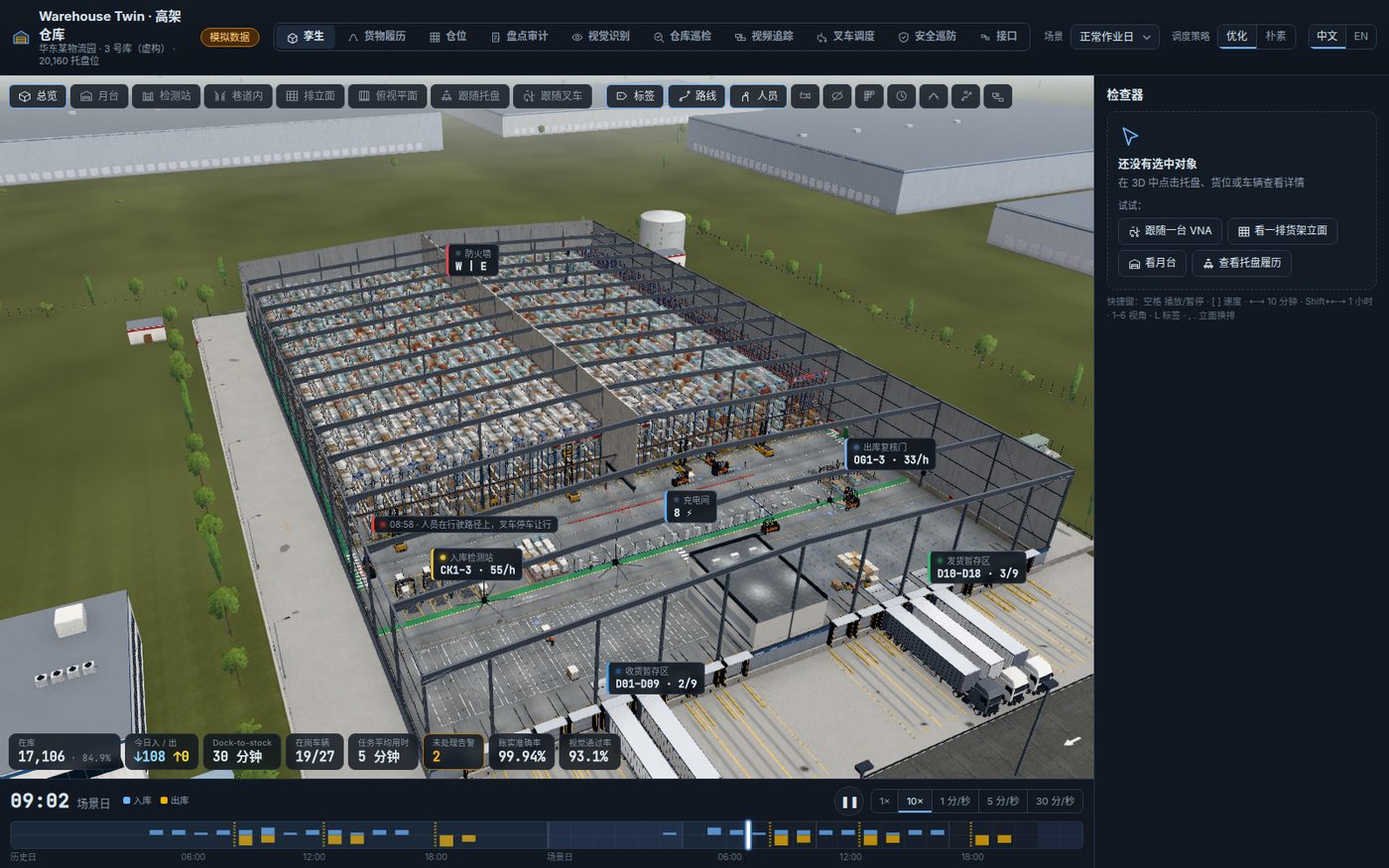
A multi-customer high-bay warehouse sized from a client site sketch: 75 m wide, 26 rack rows × 39 bays × 6 levels, 13 reach-truck aisles, eight docks and six customers across lithium batteries, food and light industry. A discrete-event simulation runs a naive and an optimised WMS twin in lockstep — slotting, dispatch, vision counts, audit and safety.
- usable pallet positions
- 11,550
- reach-truck aisles
- 13
- virtual cameras for vision tracking
- 112
- tests + browser checks
- 53 + 48
The challenge
Warehouse operators change slotting rules and truck dispatch on intuition. Nobody can show the effect on lead time and empty travel — or prove where a missing pallet went.
What we built
- Every coordinate modelled: rack rows, aisles, docks, staging lanes, swept paths without in-place pivots
- Two DES twins share the same demand: first-feasible vs scored slotting, FIFO vs Hungarian dispatch
- Segregated lithium zone with hard rules for levels, capacity and food buffer
- Vision counts, discrepancy workflow and a SHA-256 hash-chained audit log
- Patrol robot rounds, UWB proximity stops and a safety rule engine
Outcome in the twin
Strategy effects show up as measured fleet KPIs — lead time, cycles per busy hour, empty travel, aisle changes — and every pallet has a reconstructable journey from dock to slot to truck.
Path to production
Load the real WMS locations and order history, replay a peak week, and A/B the slotting rules before changing them on the floor.
Technology
About this build
Fictional warehouse and customers; every page carries a simulated-data badge.
4D Midstream Digital Twin
Restaurant Digital Twin
Have a system you want to see, question or rehearse?
Tell us about the site, the process and the decision. We will come back with what a twin could answer, which data it needs, and how fast a prototype can be in front of your team.