Restaurants know what a dish sells for and roughly what it costs. They rarely know what an ingredient earns — and that is where margin leaks hide: a supplier change, a heavier hand at the wok, a promotion that moved the mix.
The ingredient twin
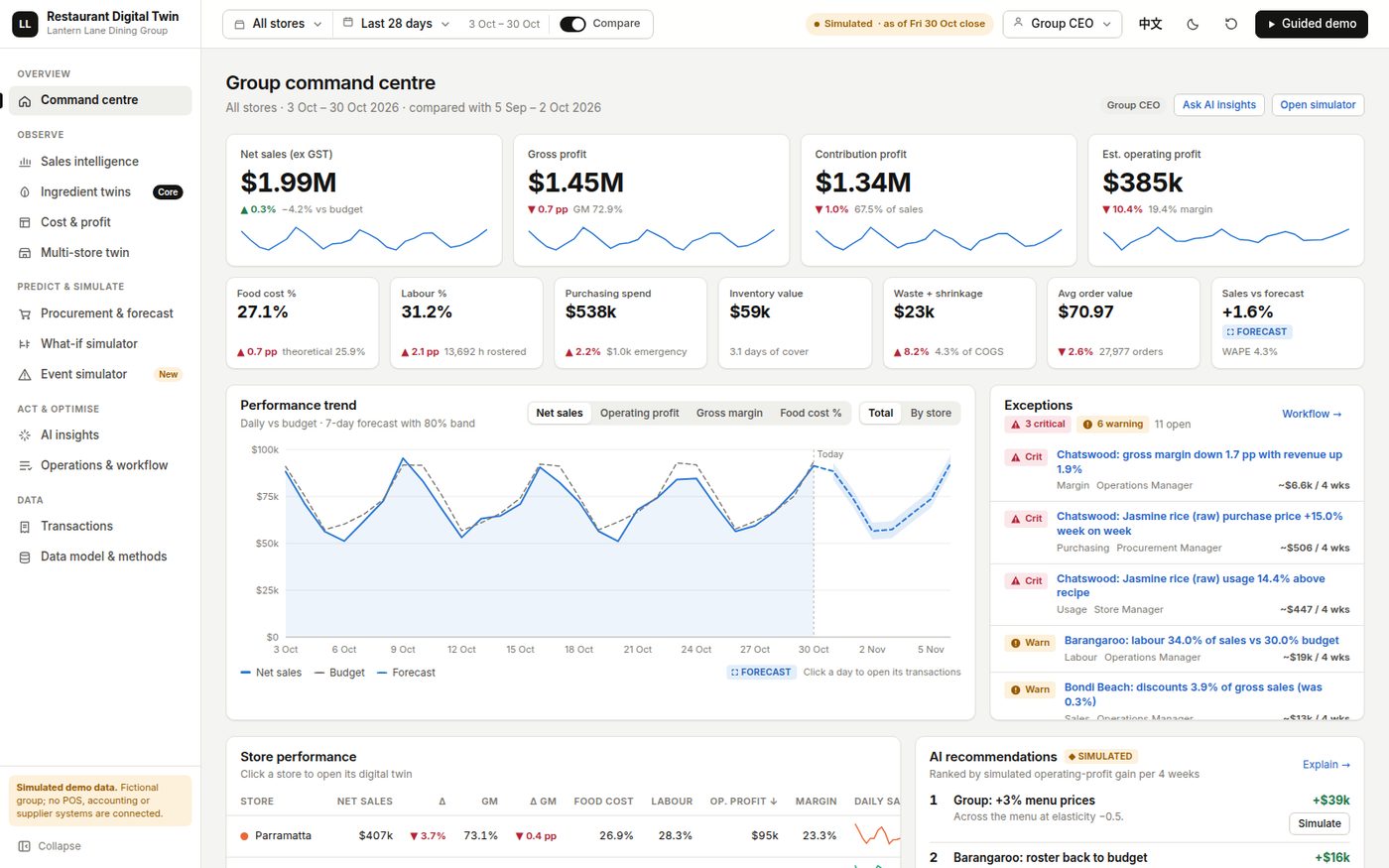
The Restaurant Digital Twin links 90 days of transactions across five stores to 60 recipes, 120 ingredients, 15 suppliers, purchase orders, waste, labour and inventory. For any ingredient it answers four questions:
- Where did it go? One kilogram of rice, split across every dish it was plated into.
- What did those dishes earn? Revenue of the dishes, net of GST.
- What profit belongs to the rice? Contribution profit allocated by an explicit, switchable rule — by cost share, by quantity, or equal share.
- What did it cost? Weighted-average cost from a perpetual inventory, not a list price.
Allocation is a modelling choice, so the twin shows the rule and lets you change it. The number moves; the reconciliation does not — 22 tests check that every allocation sums back to the P&L.
Finding the leak
In the seeded data, one store's gross margin slips by 1.7 points. The twin's alerts trace it to two causes that look unrelated in a P&L: the store started buying rice locally at a higher price, and rice usage ran 14 % over recipe. A nine-step guided demo goes from the CEO view to the ingredient, to a replenishment forecast, to an approved purchase order — and then verifies its effect on inventory.
Why a twin, not a dashboard
A dashboard reports. A twin also simulates: change a supplier price, a portion size or a promotion and see the effect on every store before committing. Because the calculation engine is independent of the data, connecting real POS, accounting and invoice feeds replaces the seeded generator without changing the logic.