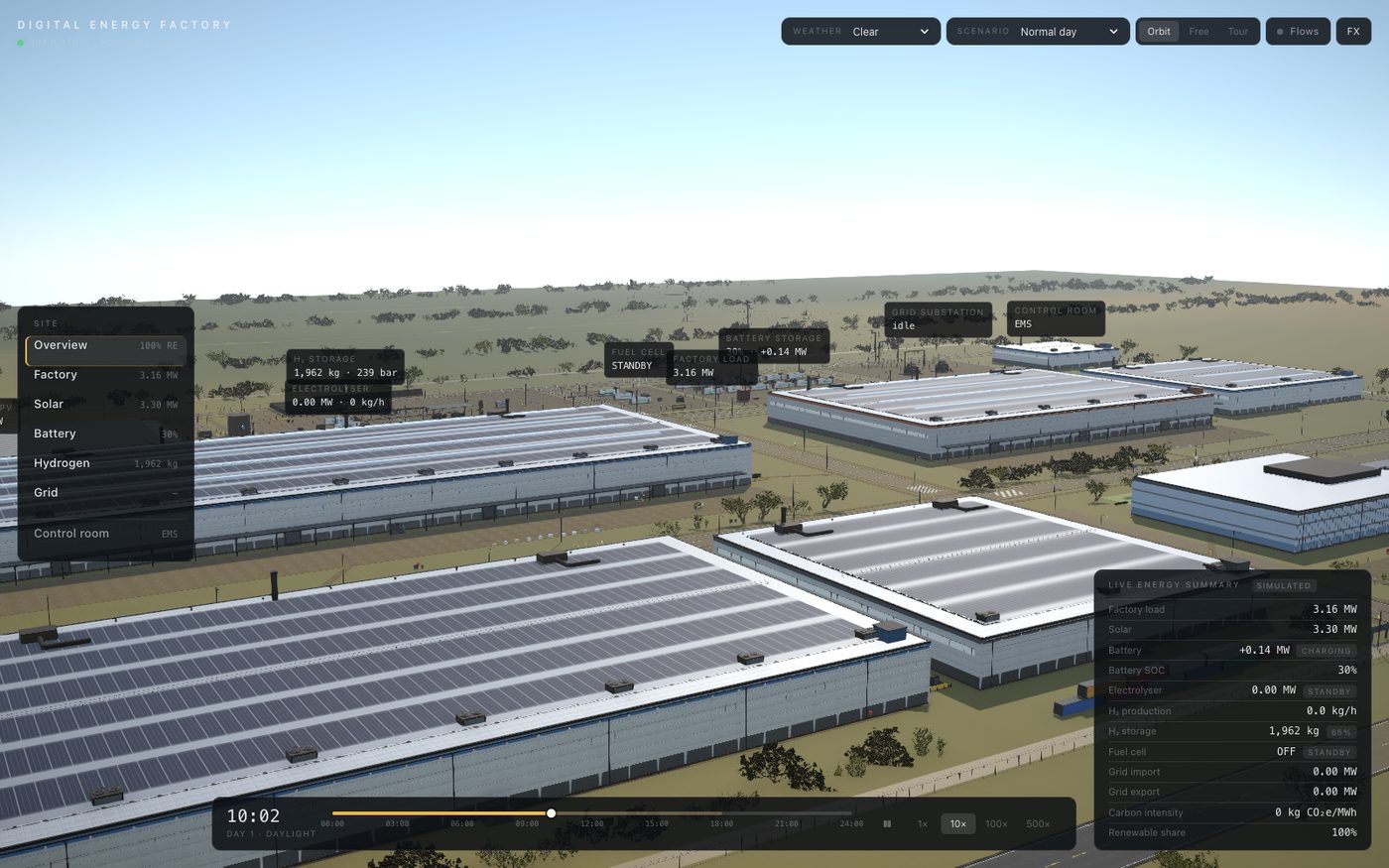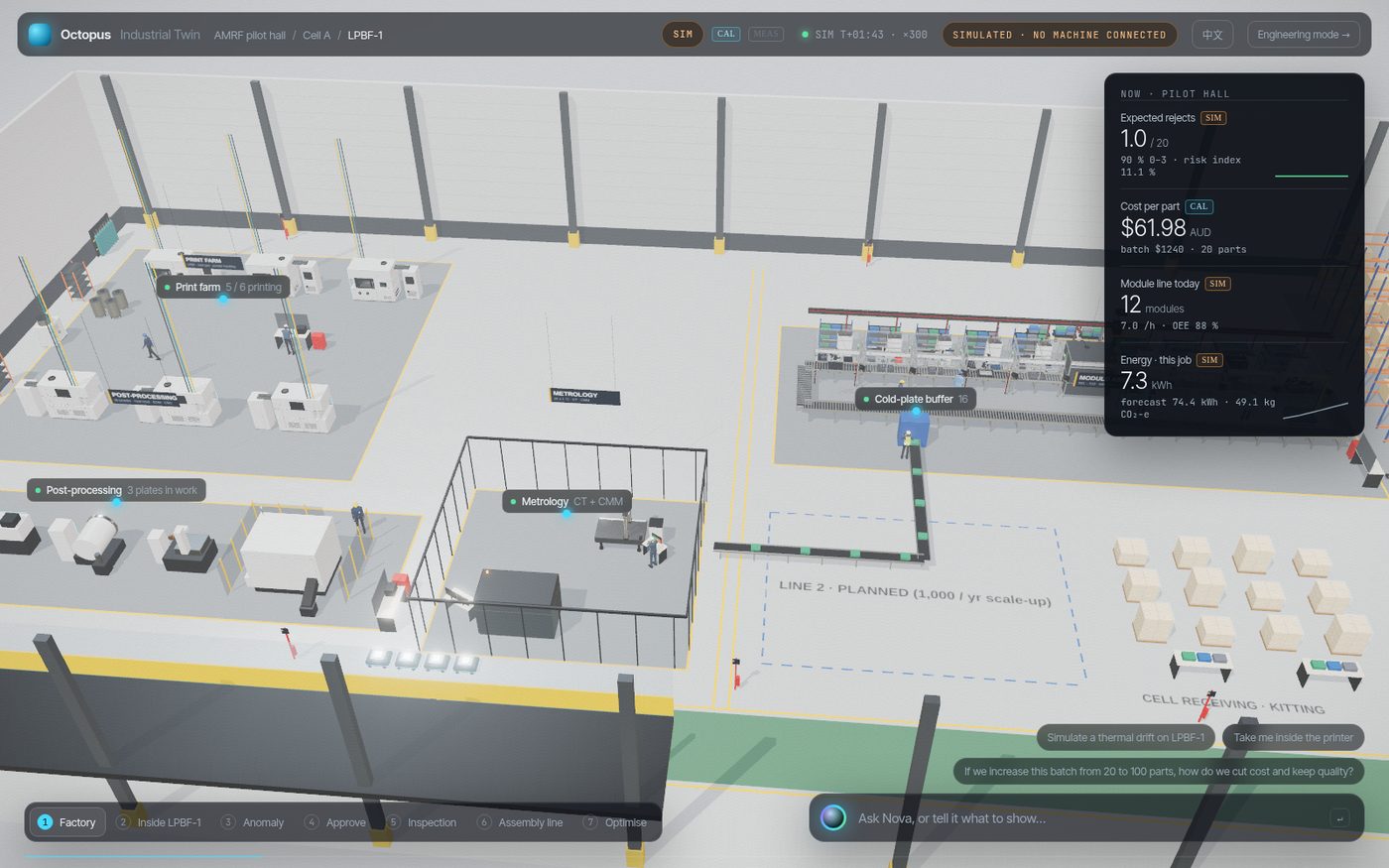
Owners of tropical resorts face a cost problem that never closes for the season. Air is hot and humid all year, guests expect a cool, dry room the moment they open the door, and the plant that delivers that comfort runs day and night. Much of it is spent on rooms that are sold but empty while guests are at the beach, on villas between stays, and on public areas that run on fixed schedules regardless of who is there. Tariffs often add a peak window in the evening, exactly when guests come back and the restaurant fills.
Meanwhile the plant ages. A fouled condenser or a slow refrigerant leak in a villa unit does not trip an alarm. It just costs a bit more every day until something fails during high season. And for a group with several properties, the head office rarely knows which resort is efficient and which is simply lucky with the weather.
What a digital twin means here
A digital twin of a resort is a working model of its buildings, its plant and its guests' movements, driven by the local weather. It runs a day at the resort as it would really happen, but in a form you can question: what would tonight cost if we ran the plant differently? The general idea is in What is a digital twin?.
Our twin does more than draw the resort. It runs two copies of it, a baseline and an optimised one, on the same weather and the same occupancy. The difference between them is a saving that has been measured in the model, not promised in a proposal.
What we built
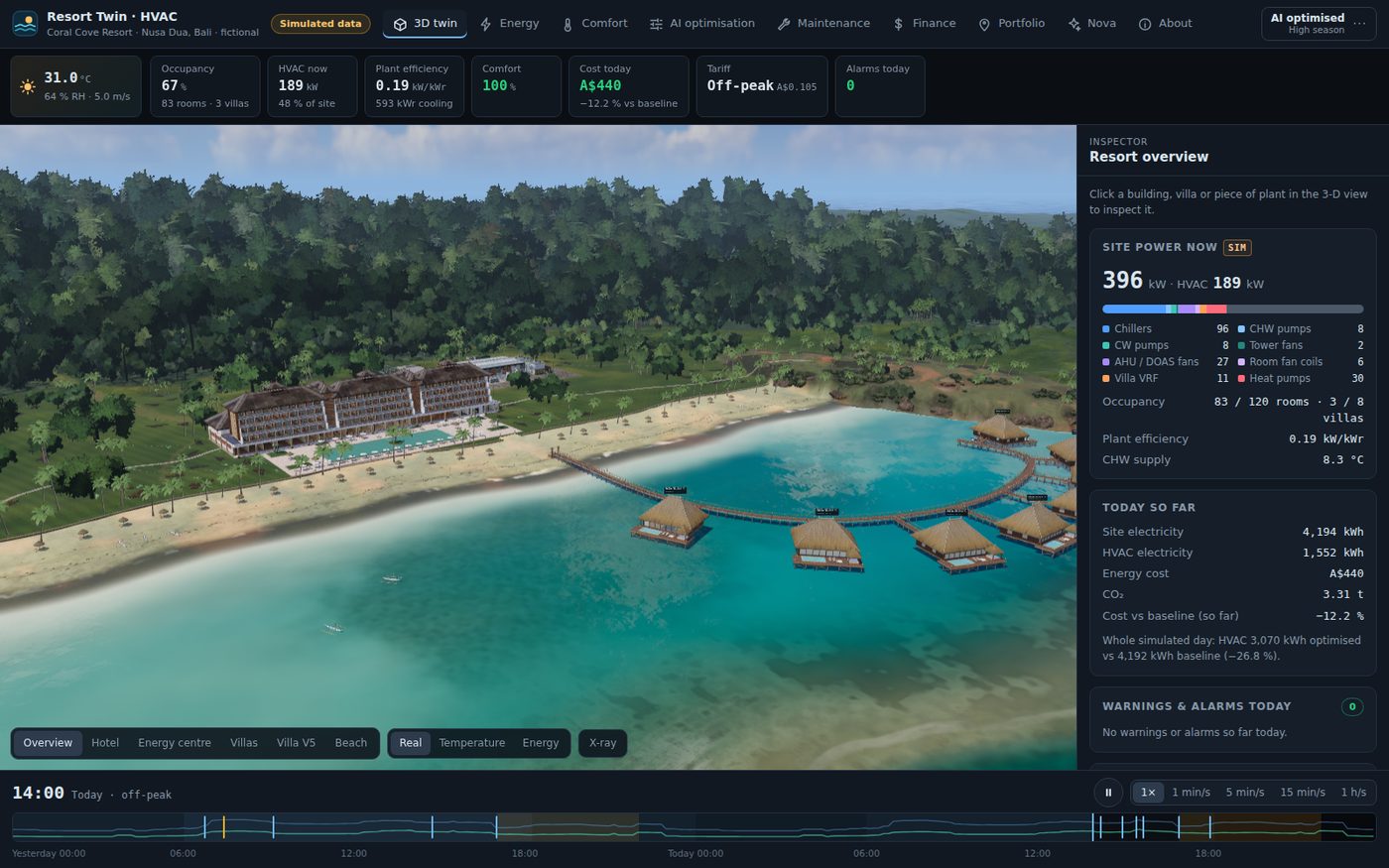
Our Resort Twin models Coral Cove Resort, a fictional beach resort in Nusa Dua, Bali, on a modelled coastline with a lagoon, a reef and a hillside.
- Three parts of one site. A five-storey main hotel with 120 rooms, a lobby, restaurant, ballroom, spa, gym and kitchen. An energy centre with three 700 kWr water-cooled chillers, three cooling-tower cells, pumps, heat pumps and hot-water storage. Eight overwater villas on a timber jetty, each with its own VRF heat pump, energy-recovery ventilator and plunge-pool heat pump.
- Guests, not schedules. An occupancy model follows sales of the 120 keys, check-out at 11:00 and check-ins in the afternoon, guests in and out of their rooms, meal services, a conference and a banquet, and villa stays.
- Physics on both sides. The chiller plant uses COP that varies with temperature lift and part load, and cooling towers that respond to wet-bulb temperature. Comfort counts only when a space is within ±1 K of setpoint and humidity is at or below 65 %. Across its scenarios the optimised strategy saves a modelled 15–28 % of HVAC energy compared with the baseline, and comfort holds.
- Maintenance, finance and portfolio on the same model. Asset health and fouling drive predictive maintenance. A chiller fault and a villa refrigerant leak are built-in scenarios. The finance view shows cost per room night and payback. A portfolio view places the resort among five fictional properties in Indonesia and Australia.
- Nova, an assistant with governance. Nova answers questions about energy, savings, villas, maintenance, finance, comfort and planning in English or Chinese. Its proposals go through approval, and each one is recorded in a hash-chained evidence log.
Decisions it helps you make
- How much cooling are we buying for rooms and villas with nobody in them?
- Which strategy, such as chilled-water reset, pre-cooling before the peak tariff, or villa setback between stays, saves most without guests noticing?
- Which chiller or villa unit is degrading, and what is it costing us before it fails?
- What is our HVAC cost per occupied room night, and how does it compare with our other properties?
- If we invest in a plant upgrade or controls, what is the payback under our own weather and occupancy?
What changes
Before: the plant runs to fixed schedules set at commissioning. Savings ideas are debated on rules of thumb. Maintenance is calendar-based or reactive. Head office compares resorts on utility bills that mix weather, occupancy and efficiency.
After: the chief engineer sees comfort and energy room by room and villa by villa, and can test a strategy on the twin before changing the BMS. Maintenance targets the units whose health is falling. The finance team gets cost per room night and payback from the same model. For a group, the portfolio view lets you compare properties on a like-for-like basis and decide where the next upgrade will pay back first.
Getting there at your resort
- Discovery. We gather drawings, plant schedules, BMS trend logs, meter readings, PMS occupancy history, tariffs and local weather, and agree on the decisions the twin must support.
- Prototype on your data. We model your buildings and plant and replay a real season of weather and occupancy, so you can compare baseline and alternative strategies. Every figure stays labelled as simulated or calibrated.
- Connected twin. We connect the BMS and utility meters, calibrate the chiller and villa models on trend data, then measure savings against the calibrated baseline. After that, the next property in the group can be onboarded.
Ask any vendor: Is the saving the difference between two models on identical inputs, or a percentage from a brochure? How is comfort defined and checked? Which numbers are calibrated on my data? Can I see the evidence behind each recommendation?
Honest limits
Coral Cove Resort and the other four properties in the portfolio are fictional. All data is simulated. No BMS, PMS or meter is connected. The 15–28 % range is a difference between two models on the same inputs, not metered measurement and verification. Occupancy follows deterministic profiles, and rooms are modelled in classes rather than as 120 individual rooms.
See it for yourself
- Live twin: resort.octopustwin.com
- Case study: Resort Twin · HVAC
- Running one resort or several? Talk to us about a twin on your own data.