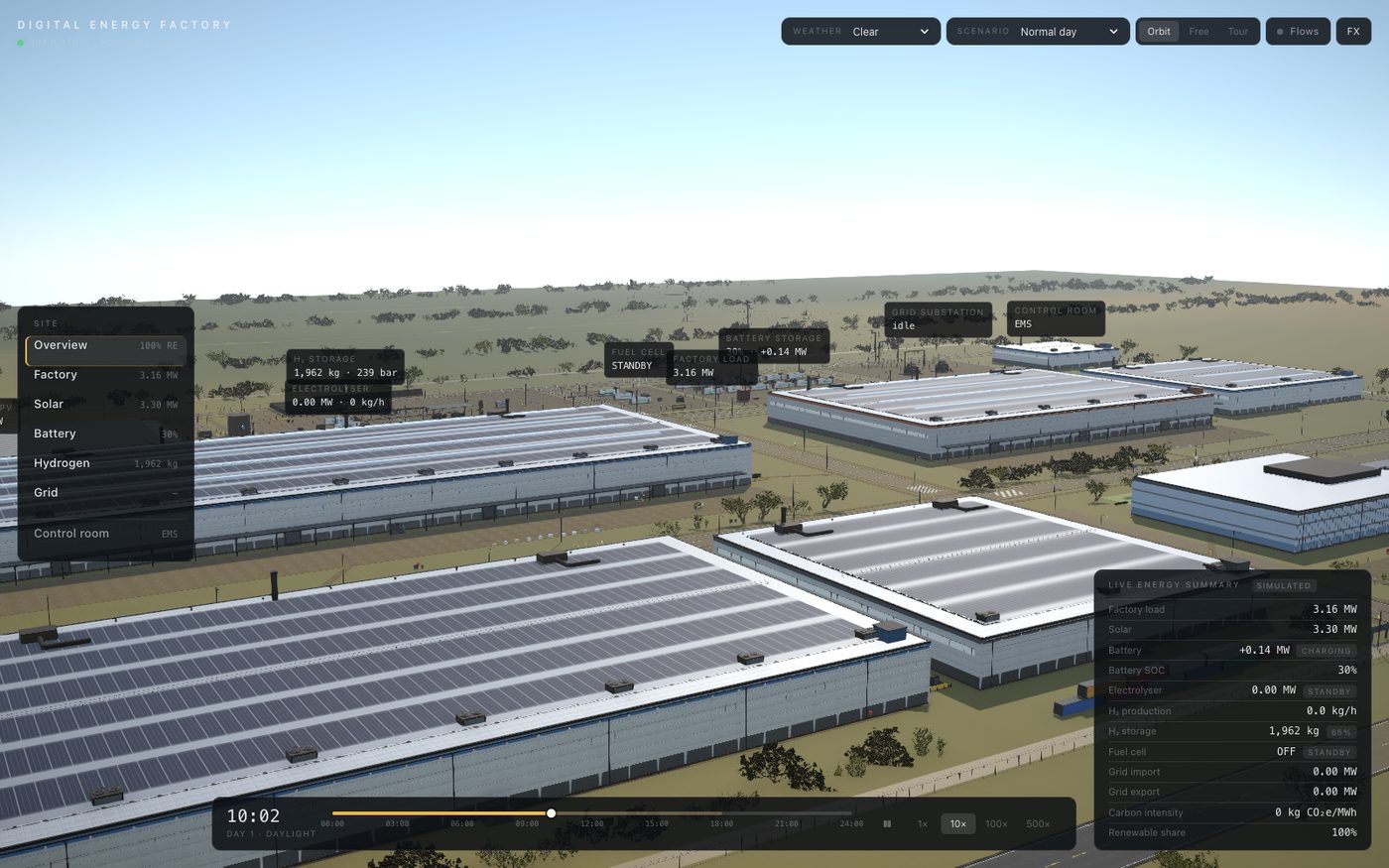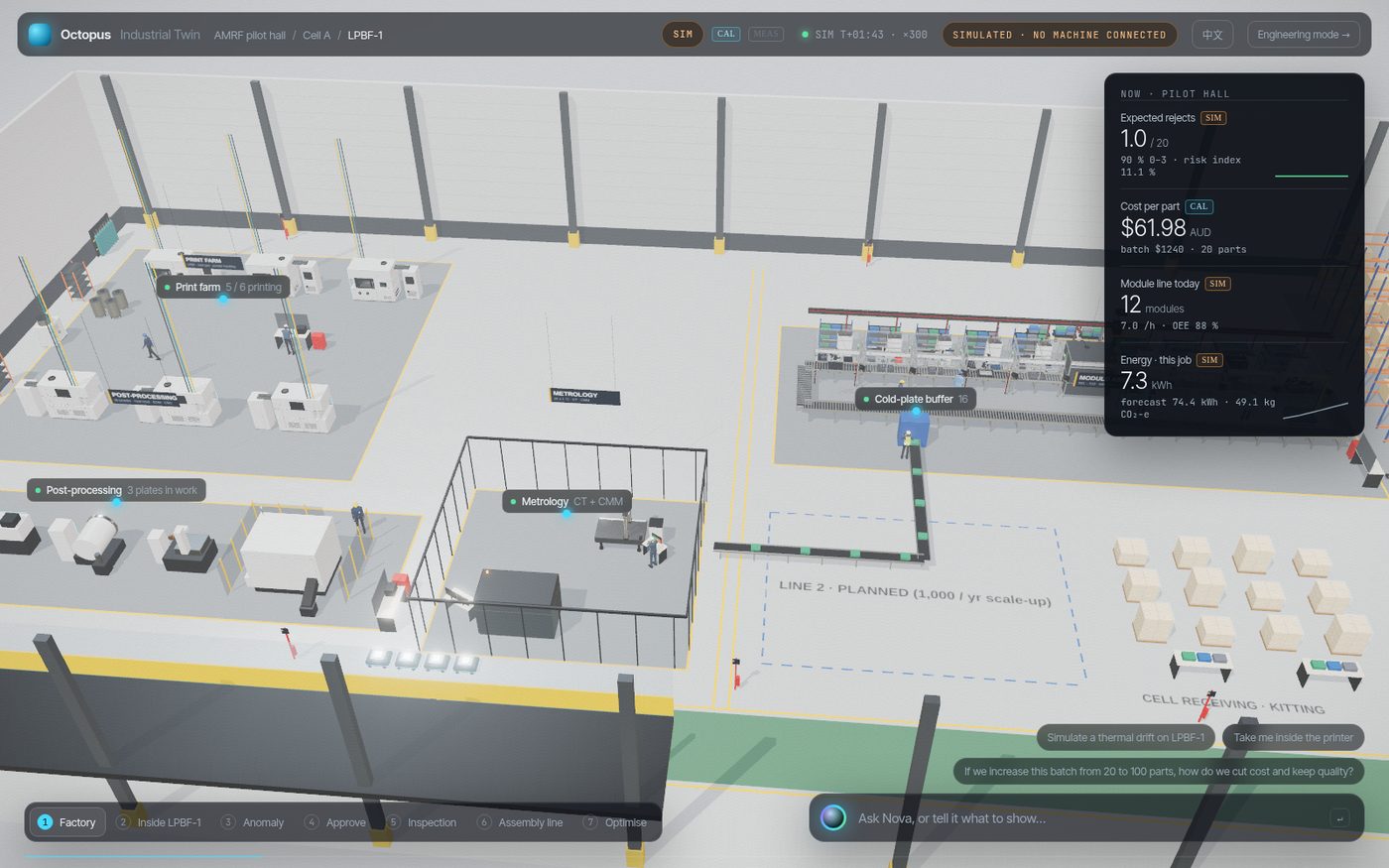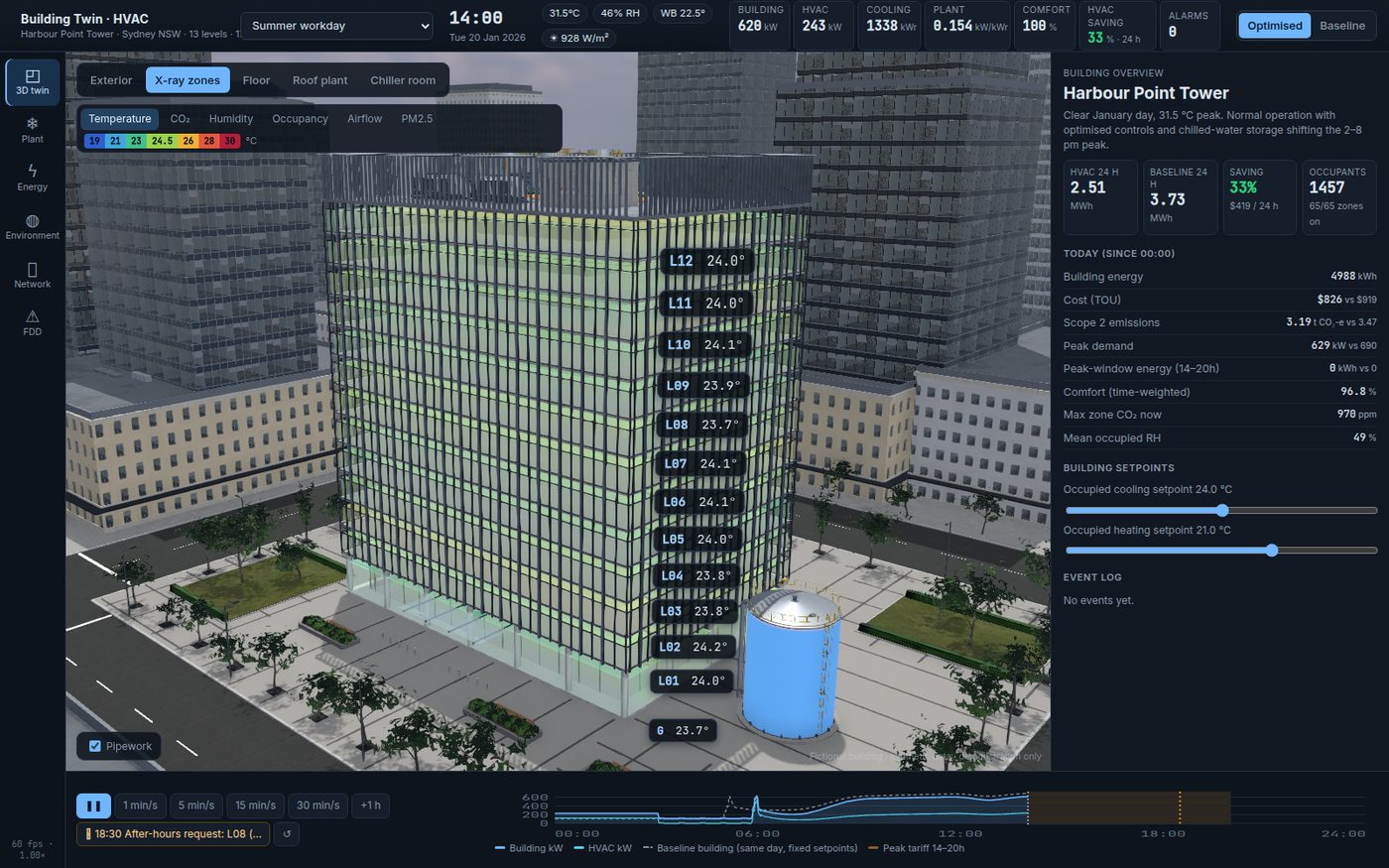
Over the past months we built a series of open digital-twin experiments: a 13-level office tower with its chiller plant, a 255 km products pipeline, a 12,000-position high-bay warehouse, a five-store restaurant group, a tomato plant that can be questioned about its own growth, a solar-and-hydrogen house, an industrial energy campus, a care centre, a visual-navigation lab, two scientific explorers — and, most recently, an additive-manufacturing facility, a 277-key harbourside hotel and a Bali beach resort with overwater villas.
Today they become Octopus Twin, the digital-twin business line of Octopus, with its own home at octopustwin.com. Every twin now lives at a subdomain of this site, grouped by industry.
What we build
A digital twin is not a 3D model. It is a model of a physical system that can answer progressively harder questions:
- What does it look like? — a digital model.
- What state is it in now? — a digital shadow, estimated from sensors.
- What happens if we run it this way? — a twin with simulation and scenarios.
- What changed, when, why, and how does it propagate into every possible future? — a 4D causal twin.
Most of our work sits in generations 3 and 4. The research page explains the framework and the small runtime kernel that makes generation 4 practical.
How we build
- Provenance first. Every number traces to a dataset, a published model or a labelled assumption. Synthetic data carries a badge on screen.
- Measured, not claimed. Savings are the difference between two twins on the same inputs — a baseline and an alternative.
- Tested. Every twin ships with unit tests, headless-browser acceptance checks and visual capture sets.
- Browser-first. No installs. A link is enough to put a twin in front of a board, a site team or a customer.
What is next
We are taking on a small number of client engagements: discovery workshops, rapid prototypes on your own site or process, and connected twins on live data. If one of the projects looks like your problem, get in touch.