If you own or run a care facility — a clinic, a therapy centre, an aged-care or disability-support site — your costs and your risks are mostly about people moving through space. Families arrive early or late and crowd reception. A therapy room is booked but too warm to use. A contractor walks into an area they should not be in. An evacuation drill happens once a year, on paper, and nobody can say afterwards whether the person in the wheelchair on the upper floor would have been out in time.
Each of these costs money: staff time spent firefighting, rooms that sit idle, incidents, insurance and accreditation findings, and in the worst case harm to someone in your care. The information to prevent them usually exists — rosters, bookings, access logs, building sensors — but it lives in separate systems and nobody sees it on one timeline.
What a digital twin means in a care setting
A digital twin is a working model of a real place or system that can be questioned, replayed and run forward. For a care facility the interesting part is not the building geometry; it is the operation: who is where, which room is in use, what the environment is doing, what happened just before an incident, and what would happen if staff responded differently.
That makes it a generation-3 twin in our terms: not just a 3D model or a live dashboard, but a model with a timeline you can scrub backwards and scenarios you can run forwards from any moment, then compare.
What we built
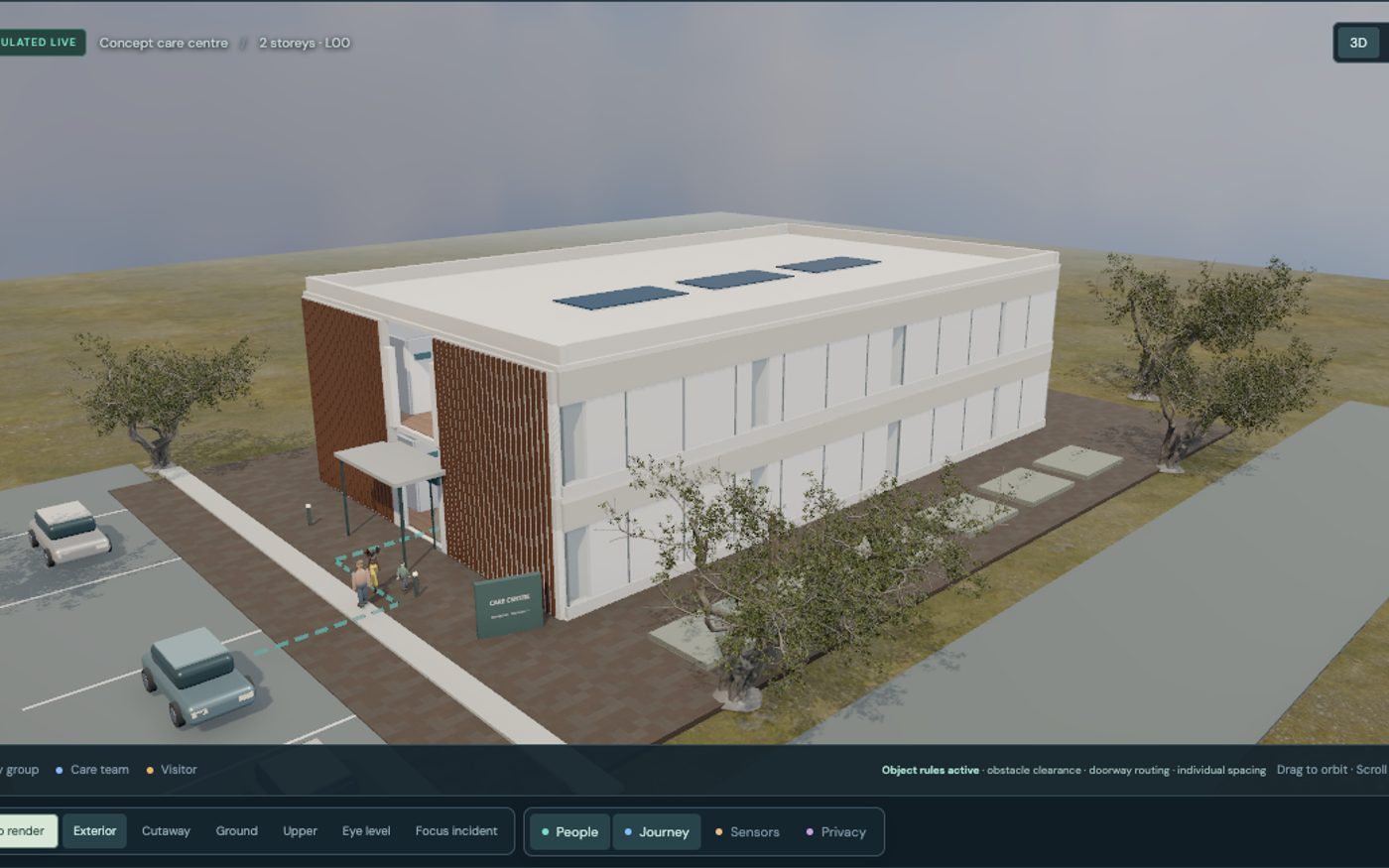
Our Facility Twin · Care is a browser-based concept demonstration of a fictional two-storey care centre. It has 16 furnished spaces over two floors, a lift and stair core, parking and landscaping, and a deterministic 4D timeline of people, appointments, room environment and events.
It walks through five operational stories:
- Supported arrival — a family travels from parking through reception to an appointment; waiting and appointment signals are shown, a suggested response can be reviewed, its future compared, and a simulated change approved.
- Restricted-area access — a contractor's path is correlated with a denied access event and the evidence behind it, and a staff response is sent only after human review.
- Comfort and environment — room temperature and CO₂ signals are traced to their source, and a ventilation response is simulated.
- Guided evacuation — visual cues, staff assistance, a step-free route and an assembly check, rehearsed as a drill.
- Fall-risk drill — a scripted movement signal appears, requires human review, and the twin shows the difference between early prevention and late assistance on the same timeline.
Three virtual public-area cameras are rendered from the same 3D world. No real camera is connected and no video is captured or kept. People in sensitive rooms are excluded from views and analytics, and a role picker demonstrates how a safety view or a front-desk view sees different detail. Every response is stamped at the time it was made, so replaying the past never rewrites it.
Questions it helps an owner answer
- Where do arrivals bunch up, and what does a small change to booking times or reception staffing do to waiting?
- If we had responded five minutes earlier, what would have been different — and can we show that to the team, the family or the regulator?
- Can every person on the upper floor reach the assembly point by a step-free route, with the staff we actually have on shift?
- Which rooms are unusable because of temperature or air quality, and when?
- Can we see what is happening operationally without seeing people where they should not be seen?
What changes
Before: incidents are reconstructed from memory and separate logs; drills are rare and hard to review; privacy is handled by keeping cameras and data away from operations altogether; improvements are argued, not shown.
After: events sit on one timeline that the team can replay together. Drills can be run as often as needed and reviewed step by step. Alternative responses are compared from the same moment, so a discussion about "what if" becomes a comparison of two futures. Privacy rules are part of the model itself, not an afterthought in a policy document.
Getting there
A useful twin of a real facility needs less than most owners expect:
- floor plans and room list (CAD or even marked-up PDFs);
- booking or appointment data, and rosters;
- access-control events;
- environmental sensors where they exist (temperature, CO₂), or a plan to add a few;
- your evacuation plan and the safety rules you already follow.
We usually work in three steps: a discovery workshop to choose two or three operational questions that matter; a prototype on your floor plan and a sample of your own data; then a connected twin that reads from your systems with the privacy rules agreed up front.
Whoever you buy from, ask: Which numbers are measured and which are assumed? How are people in private rooms excluded, and can I see that rule? Can I replay an event exactly as it was, without later edits? Who approves a response, and is that recorded?
Honest limits
This twin is a fictional concept. The building, people, appointments, telemetry and incidents are all invented, and it is inspired by a public care-service context with no affiliation or endorsement. There are no real cameras. The fall-risk signals are scripted rules for demonstration; they are not clinical probabilities or a validated fall-prediction model. The evacuation scenario is a drill, not an emergency procedure. The role picker demonstrates visibility, not authentication.
Those limits are the point of a demonstration: it shows the shape of the answer before any of your data is involved.
See it
- Live twin: facility.octopustwin.com
- Case study: Facility Twin · Care
- Talk to us about your facility: contact