
Home Energy Twin
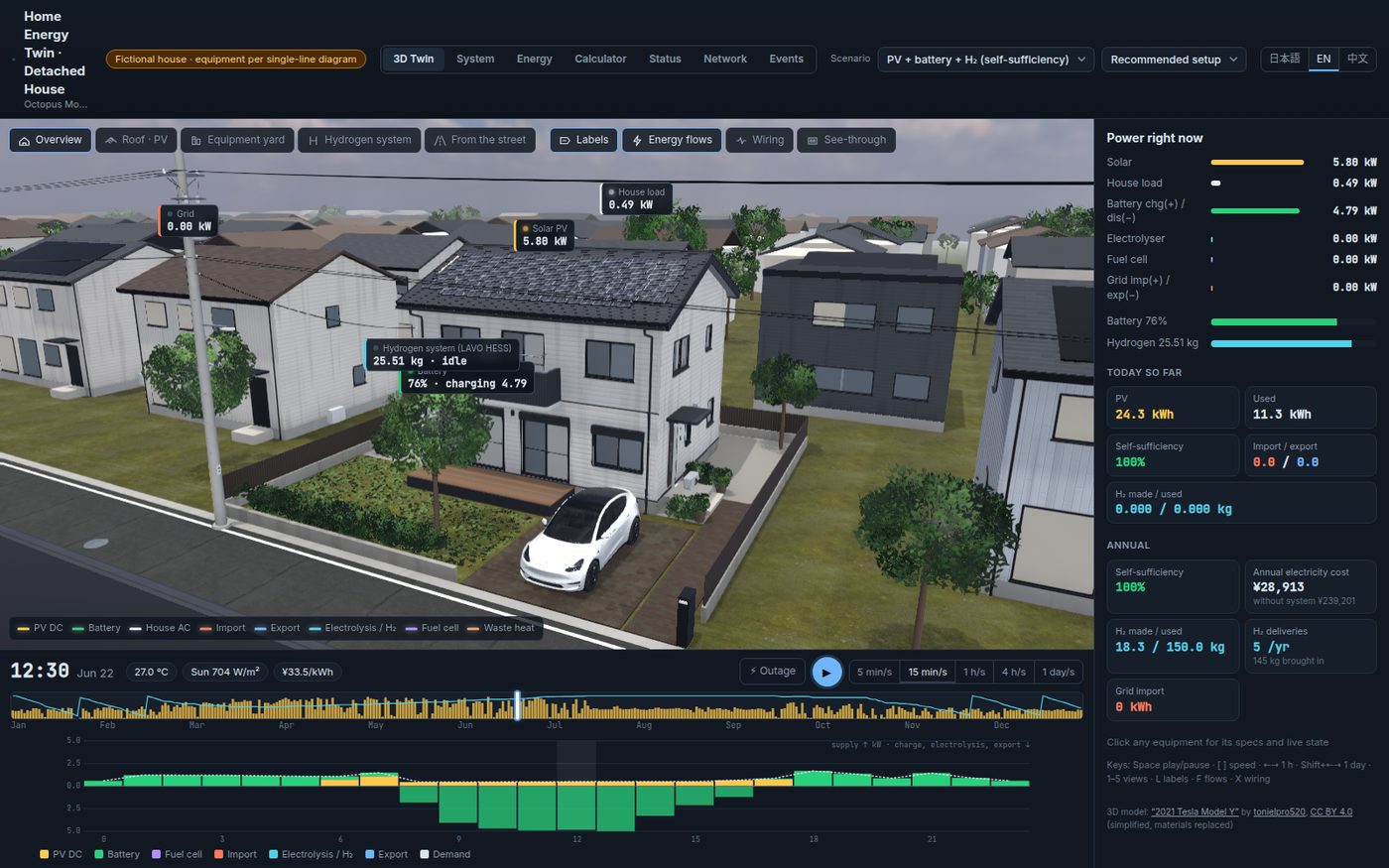
A detached house in Japan with rooftop PV, a hybrid PCS, an LFP battery and a residential hydrogen system (electrolyser → metal-hydride store → fuel cell). An hourly 8,760-hour year driven by real typical-year irradiance compares four operating strategies, with a live single-line diagram and the 3D house in one view.
- hourly steps per simulated year
- 8,760
- operating strategies compared
- 4
- annual PV yield vs PVGIS reference
- ≤ 8 %
- public solar datasets cross-checked
- 3
The challenge
Households and installers want to know whether hydrogen storage pays off next to a battery — at their location, with their roof and their load — before they commit.
What we built
- PVGIS typical-year irradiance with PVcalc and NASA POWER as cross-checks
- Sun position, plane-of-array transposition, cell temperature and inverter curve
- Hydrogen modelled from published residential HESS specifications; unpublished values listed as assumptions
- Single-line diagram drawn 1:1 from the engineering drawing, animated by the simulation
Outcome in the twin
The twin shows, hour by hour, when the battery, the hydrogen store and the grid carry the house — and what each strategy costs over a year.
Path to production
Fill the installation parameters for the real site, re-run the solar fetch for its coordinates, and cross-check against local meteorological data.
Technology
About this build
Fictional model house; parameters partly typical values. Private demo — access code on request.
Digital Energy Factory
4D Plant Digital Twin
Have a system you want to see, question or rehearse?
Tell us about the site, the process and the decision. We will come back with what a twin could answer, which data it needs, and how fast a prototype can be in front of your team.